What Is CompTIA Security+?
A beginner-friendly guide to the Security+ certification, who it is designed for, what you learn, and how it can fit into a cybersecurity career.
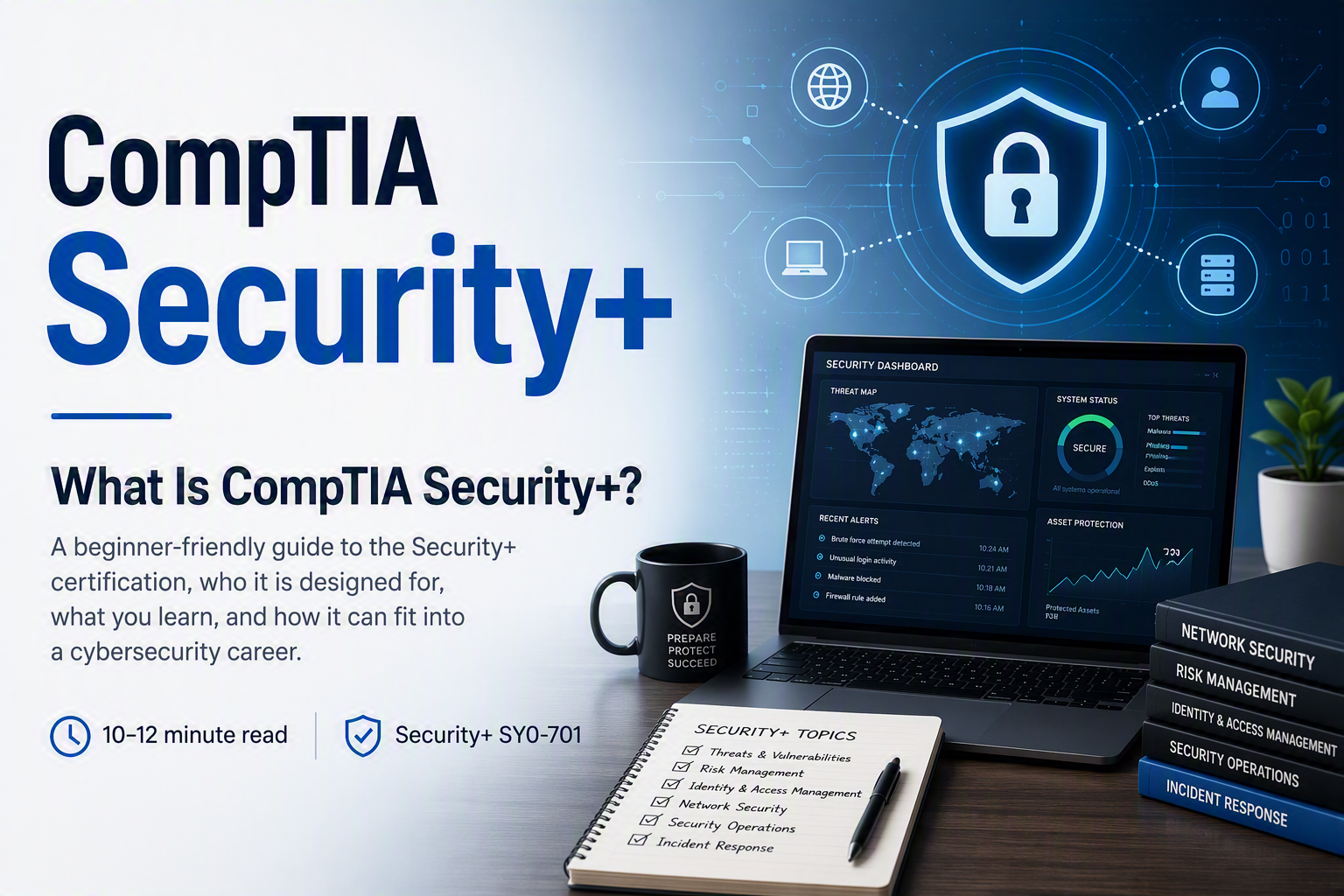
What is CompTIA Security+?
CompTIA Security+ is a vendor-neutral cybersecurity certification that validates foundational security knowledge and skills. It covers areas such as threats and vulnerabilities, security architecture, security operations, identity and access management, incident response, risk management, governance, and compliance.
If you are interested in starting a career in cybersecurity, you have probably come across the name CompTIA Security+.
Security+ is one of the certifications commonly considered by people who want to build a foundation in cybersecurity.
But what exactly is Security+? Who is it designed for? What do you actually learn? And do you need previous IT experience before studying for it?
This guide answers those questions in simple terms so you can understand what Security+ represents and whether it fits into your cybersecurity learning path.
The current Security+ certification covered in this guide is CompTIA Security+ SY0-701.
What Is CompTIA Security+?
CompTIA Security+ is a vendor-neutral cybersecurity certification from CompTIA.
Vendor-neutral means the certification focuses on cybersecurity concepts and skills that can be applied across different technologies, products, and organizations.
Instead of focusing on one specific security company's products, Security+ covers broad cybersecurity principles that can apply to networks, systems, applications, cloud environments, users, and data.
The certification is designed to demonstrate foundational knowledge in cybersecurity and security operations.
Think foundation—not finish line
Security+ is designed to establish a broad cybersecurity foundation. It does not mean that someone has mastered every cybersecurity technology or has years of professional security experience.
Who Is CompTIA Security+ For?
Security+ can be useful for people at several stages of their IT and cybersecurity journey.
Students
Students studying IT, cybersecurity, networking, or related subjects can use Security+ as a structured way to develop foundational security knowledge.
IT Professionals
Help desk technicians, system administrators, network professionals, and other IT workers can use Security+ to strengthen their understanding of cybersecurity.
Career Changers
People moving toward cybersecurity can use Security+ as part of a structured learning path while developing practical technical skills.
Early-Career Security Professionals
People beginning their security careers can use the certification to organize and validate foundational cybersecurity knowledge.
Do You Need IT Experience Before Security+?
You do not need years of professional cybersecurity experience to study for Security+.
However, having some basic IT knowledge can make the material considerably easier to understand.
Security concepts frequently depend on an understanding of how computers, operating systems, networks, applications, and users interact.
Helpful Before Security+
- Basic computer concepts
- Networking fundamentals
- Operating-system basics
- Basic troubleshooting
- Familiarity with common IT terminology
If You Are Completely New to IT
Security+ is still possible, but you may benefit from learning basic IT and networking concepts before or alongside your Security+ preparation.
You do not need to know everything before beginning Security+. The goal is to build your knowledge progressively rather than trying to master every area of IT first.
What Do You Learn in Security+?
Security+ covers a broad range of cybersecurity topics. Instead of specializing in one narrow area, the certification introduces you to many of the fundamental concepts security professionals encounter.
General Security Concepts
Learn foundational security principles, security controls, authentication, authorization, zero trust, and cryptographic concepts.
Threats and Vulnerabilities
Learn how attackers exploit systems and how organizations can identify and mitigate common threats and vulnerabilities.
Security Architecture
Understand security considerations involving enterprise infrastructure, cloud environments, virtualization, resilience, and secure design.
Security Operations
Explore monitoring, logging, vulnerability management, endpoint security, and other operational security concepts.
Identity and Access
Learn how authentication, authorization, access controls, and identity management help protect systems and information.
Incident Response
Understand the fundamentals of detecting, investigating, containing, responding to, and recovering from security incidents.
Risk Management
Learn how organizations identify, evaluate, communicate, and manage cybersecurity risks.
Governance and Compliance
Understand the role of policies, governance, compliance, auditing, awareness, and third-party risk.
What Skills Does Security+ Help You Build?
Security+ is not simply about memorizing cybersecurity definitions. A good understanding of the material can help you develop a broader security mindset.
Recognize threats, vulnerabilities, and security risks.
Understand controls used to protect systems, users, networks, and data.
Understand monitoring, logging, and indicators of security problems.
Understand the basic principles of incident response and recovery.
Is Security+ a Networking Certification?
No. Security+ is a cybersecurity certification, while CompTIA Network+ focuses primarily on networking concepts and technologies.
However, networking knowledge is extremely useful when studying cybersecurity.
Security+ includes security concepts involving networks, firewalls, VPNs, wireless security, network segmentation, ports, protocols, and network-based attacks.
Networking and security work together
Understanding how network traffic, devices, protocols, and services work makes it easier to understand how those same systems can be attacked and protected.
If you are deciding between the two certifications, see our guide:
Is CompTIA Security+ Difficult?
Security+ can be challenging, particularly if you are new to IT or cybersecurity.
One reason is the breadth of the material. You are expected to understand concepts across many different areas of cybersecurity rather than focusing on one technology.
Another challenge is applying knowledge to realistic situations. Understanding a definition is different from knowing which security control or response is appropriate in a particular scenario.
Avoid studying through memorization alone
Try to understand what a technology does, why it is used, what problem it solves, and when it would be appropriate. This approach can make scenario-based questions easier to understand.
For a deeper look at the difficulty of the certification, see:
How Should a Beginner Study for Security+?
There is no single study method that works for everyone. A strong preparation strategy usually combines learning, practice, review, and hands-on experience.
Learn the Concepts
Start by understanding the major cybersecurity concepts instead of immediately trying to memorize large lists of terminology.
Practice Questions
Use practice questions to determine whether you can apply what you have learned and identify weak areas.
Get Hands-On Practice
Build small labs and practice with security tools where possible so that concepts become more than vocabulary.
Review Weak Areas
Use your practice results to focus additional study time on topics that you do not understand well.
Consistency is usually more useful than trying to learn everything in one long study session.
Security+ SY0-701 Learning Cards
Reinforce Security+ concepts with short, focused learning sessions.
Start LearningCan Security+ Help With a Cybersecurity Career?
Security+ can be useful as part of a broader cybersecurity career-development plan.
The certification can demonstrate that you have intentionally studied foundational cybersecurity concepts.
However, it is important to keep expectations realistic. Security+ does not guarantee a cybersecurity job.
Build more than a certification
Combine certification study with networking knowledge, hands-on labs, technical projects, IT experience, communication skills, and continued learning.
Depending on your existing experience and qualifications, Security+ knowledge can be relevant to career paths involving security analysis, security operations, network security, system administration, IT support, and other technology roles.
Frequently Asked Questions
Is Security+ good for beginners?
Yes. Security+ can be a useful starting point for people entering cybersecurity. Basic IT and networking knowledge can make the material easier to understand.
Do I need Network+ first?
No. Network+ is not a prerequisite for Security+. However, networking knowledge can be very helpful during Security+ preparation.
Can Security+ get me a job?
Security+ can strengthen a resume, but certification alone does not guarantee employment. Employers may also consider experience, technical skills, education, and other qualifications.
What should I study first?
Start with basic IT and networking concepts if they are unfamiliar. Then work through the Security+ objectives systematically.
What version should I study?
Make sure your preparation materials match the current Security+ SY0-701 exam rather than an older exam version.
What comes after Security+?
You can continue building hands-on experience, strengthen networking or cloud skills, or move toward more specialized areas of cybersecurity.
So, What Is CompTIA Security+?
CompTIA Security+ is a foundational, vendor-neutral cybersecurity certification. It is designed to help demonstrate knowledge across a broad range of security concepts, including threats and vulnerabilities, security architecture, security operations, identity and access management, incident response, risk management, governance, and compliance.
For someone beginning a cybersecurity career, Security+ can provide a structured framework for learning the fundamentals.
For someone already working in IT, it can help connect existing technical knowledge with cybersecurity concepts.
But the certification should not be viewed as the finish line. The strongest cybersecurity learning path combines knowledge with practice and experience.
Learn
Build a strong understanding of cybersecurity fundamentals.
Practice
Apply what you learn through labs, projects, and practical exercises.
Validate
Use certification to demonstrate structured cybersecurity knowledge.
Continue
Keep developing technical skills and specialize as your career progresses.
Start Building Your Security+ Foundation
Learn Security+ concepts, practice what you know, identify weak areas, and build your cybersecurity knowledge one step at a time.
Important: Certification requirements, exam versions, employer expectations, and career opportunities can change over time. Always verify current certification information and requirements before registering for an exam.