Best Security+ Study Plan for 2026: 30, 60 & 90 Day Strategies
Build a realistic Security+ study schedule, learn what to study first, practice effectively, and know when you are ready for the SY0-701 exam.
What Is the Best Security+ Study Plan?
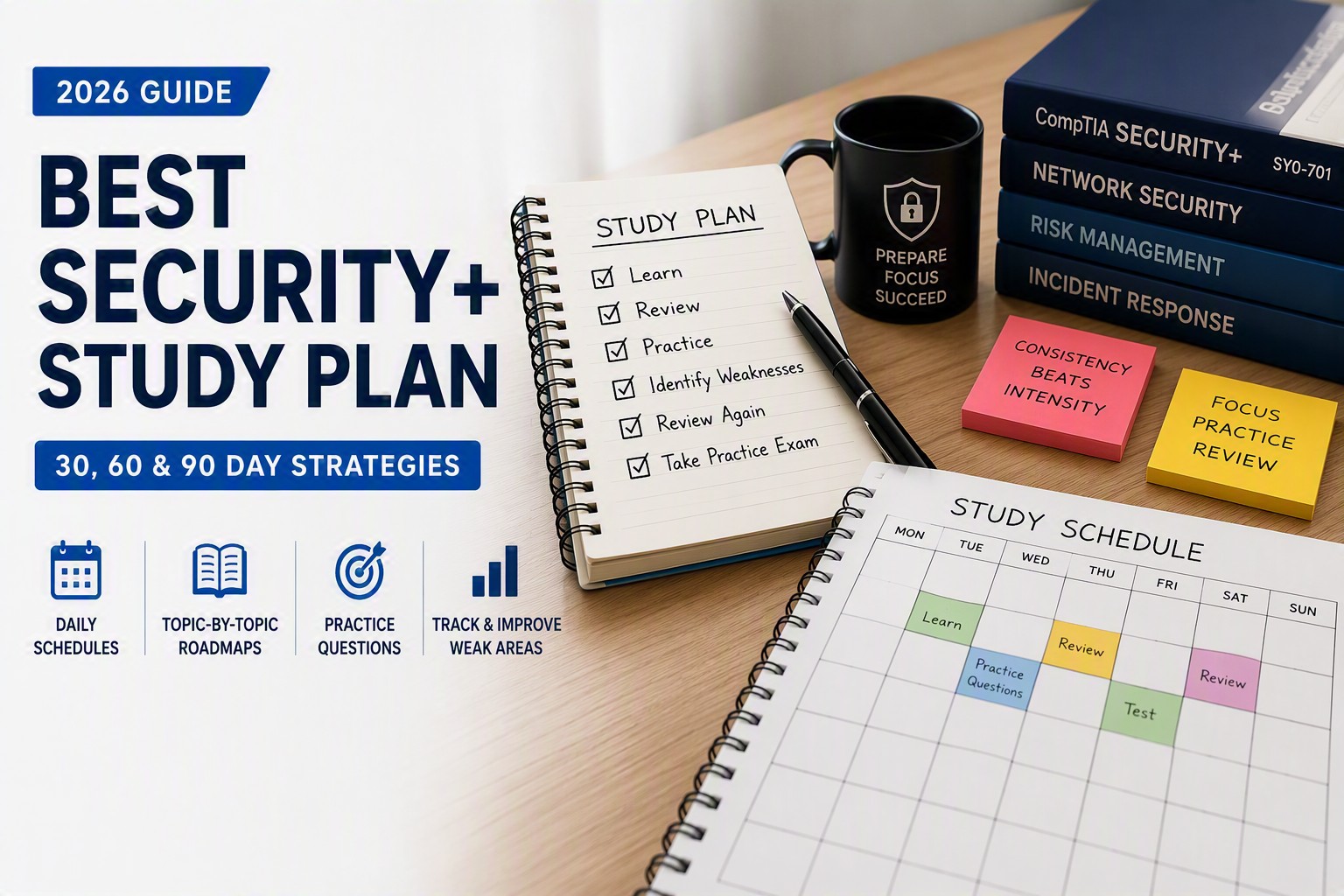
The best Security+ study plan is one you can follow consistently. Start with the current SY0-701 objectives, learn the concepts, use active recall, practice scenario-based questions, identify weak areas, and spend the final part of your preparation reviewing instead of trying to learn everything at the last minute.
Studying for CompTIA Security+ can feel overwhelming because there is a lot of cybersecurity terminology to learn.
The solution is not necessarily studying more. It is studying with a plan.
A good Security+ study plan gives you a clear sequence: learn → recall → practice → identify gaps → review → repeat.
The current Security+ exam is SY0-701 . CompTIA lists a maximum of 90 questions and a 90-minute exam time, with multiple-choice and performance-based questions. The listed passing score is 750 on a 100–900 scale. :contentReference[oaicite:1]{index=1}
This guide gives you three different preparation schedules so you can choose a pace that fits your situation.
Before You Start Studying for Security+
Before opening a video course or memorizing acronyms, establish where you are starting.
Check Your Networking Knowledge
Make sure you understand basic concepts such as IP addressing, ports, protocols, network devices, and common network security technologies.
Review Security Fundamentals
Know the basic ideas behind confidentiality, integrity, availability, authentication, authorization, and security controls.
Start With the Objectives
Use the current SY0-701 objectives as your roadmap instead of randomly jumping between unrelated study topics.
If you are still deciding whether Security+ is right for you, read: Security+ vs Network+: Which Certification Should You Get First?
The Security+ Study Method That Actually Works
Avoid building a study plan around simply watching videos from beginning to end.
Passive exposure can make material feel familiar without proving that you can actually recall or apply it.
Instead, use a five-step cycle.
Learn
Study one topic and focus on understanding what it means and why it matters.
Recall
Close your notes and explain the concept from memory.
Practice
Answer questions that require you to apply the concept.
Diagnose
Identify why you missed a question instead of simply looking at the correct answer.
Review
Return to weak concepts and test yourself again.
Don't confuse recognition with mastery
Seeing an acronym and thinking "I have seen that before" is different from being able to explain what it means, when it is used, what problem it solves, and what happens when it is misconfigured.
30-Day Security+ Study Plan
A 30-day plan is aggressive. It can make sense for someone who already has IT and networking experience and can maintain a consistent study schedule.
The goal is not to memorize the entire cybersecurity field in one month. The goal is to systematically work through the exam objectives and identify your weakest areas.
Build the Foundation
- Review the exam objectives.
- Security concepts.
- Security controls.
- Basic cryptography.
- Identity and access concepts.
Threats & Architecture
- Threat actors.
- Attack vectors.
- Vulnerabilities.
- Security architecture.
- Secure design concepts.
Security Operations
- Monitoring.
- Incident response.
- Vulnerability management.
- Security tools.
- Operational security.
Review & Practice
- Practice questions.
- Weak-domain review.
- Acronym review.
- Scenario practice.
- Final readiness assessment.
Consistency Matters More Than Marathon Sessions
If you only have a month, avoid spending several days perfecting one topic. Keep moving through the objectives and return to weak areas during your review cycles.
We also have a dedicated guide exploring the question: Can You Pass Security+ in One Month?
60-Day Security+ Study Plan
For many learners, 60 days provides a better balance between learning new concepts and retaining what they have already studied.
Foundations
Build your understanding of fundamental security concepts, terminology, controls, authentication, and cryptography.
Threats & Architecture
Study threats, vulnerabilities, mitigations, architecture, cloud, application, and infrastructure security.
Operations
Focus on security operations, monitoring, incident response, vulnerability management, and related technologies.
Practice & Review
Shift progressively from learning new material toward practice, diagnosis, review, and exam readiness.
90-Day Security+ Study Plan
A 90-day plan is ideal if you are balancing Security+ with work, school, family, or other responsibilities.
You can use shorter study sessions while giving yourself more opportunities to revisit material.
Days 1–30 — Learn
Work through the exam objectives at a comfortable pace. Focus heavily on understanding rather than memorization.
Days 31–60 — Reinforce
Begin structured practice. Use questions to expose weak areas and revisit concepts you cannot explain confidently.
Days 61–75 — Apply
Spend more time applying concepts to scenarios and less time passively consuming study material.
Days 76–90 — Prepare
Focus on weak objectives, practice, review, pacing, and final readiness.
A Simple Daily Security+ Study Schedule
You do not need an elaborate schedule. A repeatable routine is often easier to maintain.
| Time | Activity | Purpose |
|---|---|---|
| 15 min | Previous-topic recall | Strengthen retention |
| 30–45 min | New material | Build knowledge |
| 15 min | Learning cards / active recall | Reinforce key concepts |
| 20–30 min | Practice questions | Apply knowledge |
| 10 min | Error review | Identify weak areas |
You can shorten or extend these blocks based on your available time. The important part is maintaining the cycle.
How to Use Security+ Practice Questions
Practice questions are most useful when you use them as a diagnostic tool.
Getting a question wrong is not automatically a bad result. A wrong answer can show you exactly what needs additional study.
Don't Just Memorize the Answer
Knowing that option B is correct does not necessarily mean you understand the underlying concept.
Ask Why
Explain why the correct answer works and why the other choices are less appropriate.
Revisit the Concept
If you miss several questions around the same topic, return to the underlying material.
Security+ SY0-701 Learning Cards
Use short learning sessions to review concepts, recall terminology, and reinforce material throughout your study plan.
Explore the Learning CardsSecurity+ Practice Quiz
Test what you know and use incorrect answers to identify areas that deserve another review.
Take the QuizHow to Fix Your Weak Security+ Areas
One of the biggest mistakes learners make is repeatedly studying material they already know.
Your study plan should become increasingly personalized as you progress.
Track Your Mistakes
Keep a simple list of concepts you repeatedly miss.
Find the Underlying Concept
Don't just memorize the correct answer. Determine what concept caused the mistake.
Relearn
Return to your notes, course material, learning cards, or another trusted resource.
Retest
Come back later and see whether you can answer a new question involving the same concept.
Your Final Week Before Security+
Your final week should not feel like the first week of studying.
By this point, you should be transitioning from learning new material toward reinforcing what you already studied.
Full Review
Review the objectives and identify your remaining weak areas.
Targeted Practice
Concentrate on concepts that continue to cause mistakes.
Light Review
Review key concepts and terminology without trying to relearn the entire course.
Rest
Avoid an all-day cram session. Give yourself time to rest and prepare mentally.
How Do You Know When You're Ready?
A practice-test score alone should not determine whether you are ready.
Ask yourself whether you can actually explain the concepts.
You Understand Concepts
You can explain important concepts without simply reading definitions.
You Have Covered the Objectives
You have systematically worked through the current exam objectives.
You Can Apply Knowledge
You can reason through unfamiliar scenarios instead of relying entirely on memorized answers.
Your Performance Is Consistent
Your practice performance is stable rather than depending on one unusually good attempt.
The Best Security+ Study Plan Is the One You Can Finish
There is no magic number of days that guarantees a Security+ pass.
A 30-day plan may work for someone with strong existing IT and networking knowledge. A 60-day plan may provide a better balance. A 90-day plan may be the most realistic option for someone balancing work, school, or family responsibilities.
What matters most is the quality of your study cycle: learn, recall, practice, diagnose, review, and repeat.
Don't measure your preparation only by how many hours you have studied. Measure it by how well you can explain and apply the concepts.
Turn Your Study Plan Into Daily Practice
Use focused learning cards and practice questions to turn your Security+ study plan into consistent daily sessions.
Important: Exam versions, objectives, policies, and certification information can change. Verify the current Security+ information and exam objectives with CompTIA before scheduling your exam.