Is CompTIA Security+ Worth It in 2026?
A practical look at the benefits, limitations, career value, and real-world usefulness of Security+ before you invest your time and money.
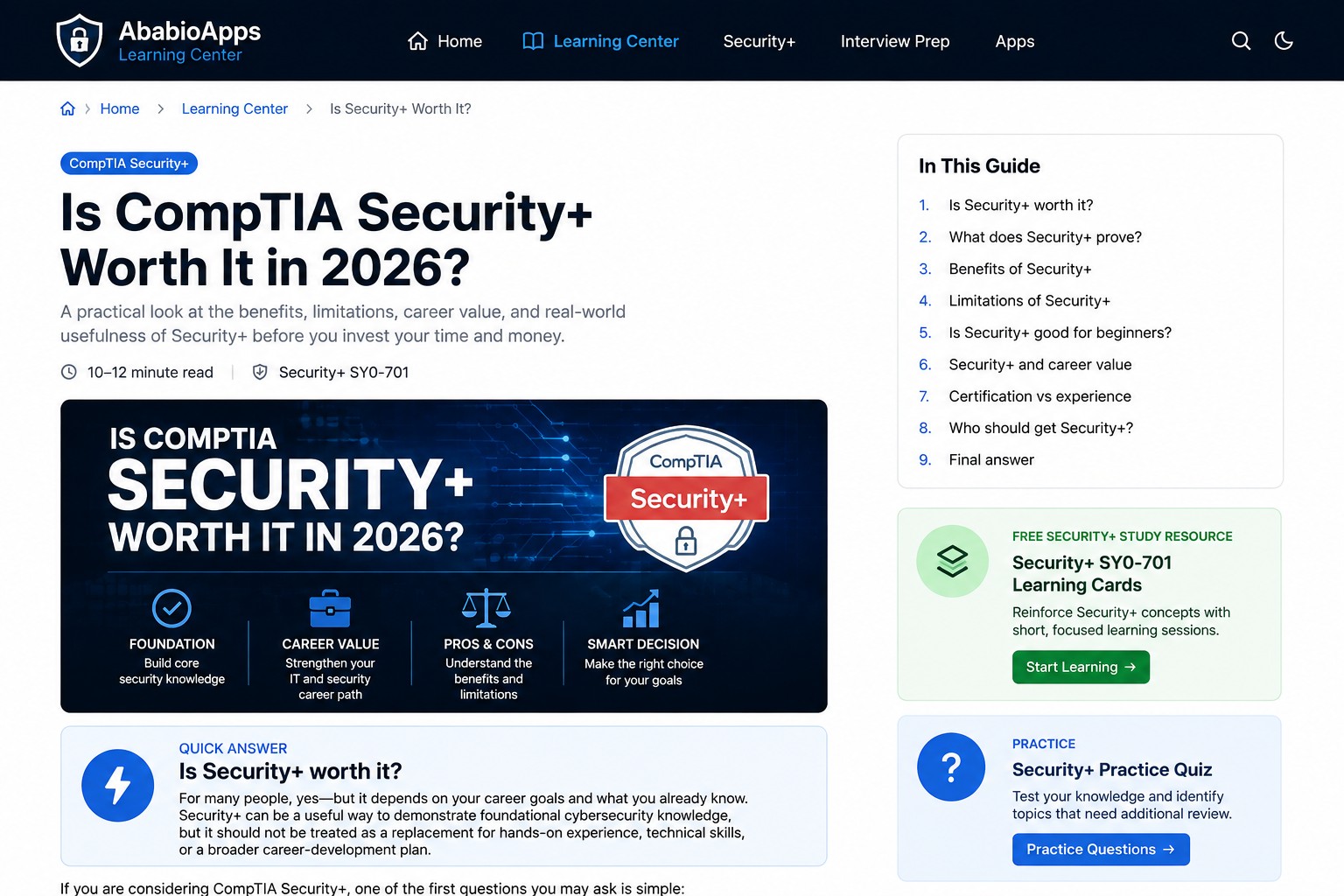
Is Security+ worth it?
For many people, yes—but it depends on your career goals and what you already know. Security+ can be a useful way to demonstrate foundational cybersecurity knowledge, but it should not be treated as a replacement for hands-on experience, technical skills, or a broader career-development plan.
If you are considering CompTIA Security+, one of the first questions you may ask is simple:
Is Security+ actually worth the time and money?
The answer depends on where you are starting, where you want your career to go, and what you expect the certification to accomplish.
Security+ is designed around foundational cybersecurity knowledge. That makes it potentially valuable for people moving into security, strengthening an IT resume, or building a structured foundation before moving toward more specialized cybersecurity skills.
But there is an important distinction: a certification can demonstrate knowledge; it cannot automatically demonstrate years of real-world experience.
So before deciding whether Security+ is worth it, it helps to understand what the certification can realistically do for you—and what it cannot.
What Does CompTIA Security+ Prove?
Security+ is most useful when you think of it as a way to demonstrate a foundation in cybersecurity concepts. It is not designed to prove that you have mastered every cybersecurity technology or that you are ready to perform every security job.
Instead, the certification can help demonstrate that you have studied topics such as threats, vulnerabilities, security architecture, security operations, identity and access, incident response, governance, risk, and compliance.
Think foundation—not finish line
Security+ can be an important milestone in a cybersecurity learning path, but it should usually be treated as a foundation that you build on with experience and additional technical skills.
7 Reasons Security+ May Be Worth It
There are several reasons people choose Security+ as part of their cybersecurity development.
1. Builds a Security Foundation
Security+ gives you a structured way to study a broad range of cybersecurity concepts instead of learning individual topics randomly.
2. Adds a Recognizable Credential
A recognized certification can give employers a clearer signal that you have intentionally studied cybersecurity fundamentals.
3. Connects Networking and Security
Security becomes easier to understand when you know how networks, systems, identity, applications, and users interact.
4. Creates a Learning Roadmap
The exam objectives provide a defined set of subjects to study, which can be especially helpful when you do not know where to begin.
5. Can Strengthen an IT Resume
For someone already working in IT, Security+ can help demonstrate that security knowledge is part of their professional development.
6. Provides a Base for Further Study
Security+ can serve as a foundation before pursuing more specialized security, cloud, networking, or security-analysis skills.
7. Forces Structured Learning
Preparing for a certification gives you deadlines, objectives, practice, and a measurable goal.
8. Encourages Hands-On Practice
The certification can be used as a starting point for building labs, practicing security tools, and connecting theory to real systems.
When Security+ May Not Be Worth It
Security+ is useful, but it is not automatically the right choice for everyone. The certification becomes less valuable if you are pursuing it without a clear reason or expecting it to do something it was never designed to do.
A certification is not a job guarantee
Passing Security+ does not guarantee a cybersecurity job, a specific salary, or an automatic promotion. Employers may also evaluate your experience, technical ability, education, communication skills, projects, and ability to solve real problems.
You may want a different path if...
- You already have substantial cybersecurity experience and need a more specialized credential.
- Your target role requires a specific technology or platform skill.
- You have not yet built basic IT and networking knowledge.
- You are collecting certifications without building practical skills.
Is Security+ Good for Beginners?
Security+ can be a good starting point for someone entering cybersecurity, but "beginner" can mean very different things.
A person who is new to cybersecurity but already understands computers, networking, operating systems, troubleshooting, and basic IT concepts is in a very different position from someone completely new to technology.
Security+ may fit you if...
- You understand basic IT concepts.
- You have some networking knowledge.
- You want a structured cybersecurity learning path.
- You are willing to practice beyond memorization.
Consider foundations first if...
- Networking concepts are completely unfamiliar.
- Operating-system concepts are new.
- Basic troubleshooting is unfamiliar.
- Cybersecurity terminology is entirely new to you.
If you are in the second group, that does not mean Security+ is off-limits. It simply means that spending additional time building your foundation may make Security+ preparation much easier.
If you are deciding between networking and cybersecurity certifications, our guide on Security+ vs Network+ will help you compare the two paths.
Does Security+ Help With a Cybersecurity Career?
It can, but the most realistic way to think about Security+ is as one component of your career profile.
A strong cybersecurity candidate may combine several elements:
Security fundamentals and concepts.
A credential demonstrating structured study.
Labs, projects, troubleshooting, and hands-on learning.
Applying those skills in real environments.
That combination is much stronger than simply collecting certifications.
Think beyond the certification
While studying Security+, build something at the same time. Set up a small lab, analyze logs, practice network security, explore vulnerability management, or document security projects. The goal is to turn knowledge into demonstrable ability.
Security+ vs. Real-World Experience
One of the biggest mistakes people make is treating certification and experience as interchangeable. They are not.
What Security+ Can Show
- Structured cybersecurity study
- Familiarity with security concepts
- Understanding of security terminology
- Commitment to professional development
What Experience Can Show
- Troubleshooting ability
- Practical technical skills
- Decision-making under real conditions
- Ability to work with actual systems and users
The strongest approach is usually not choosing between the two. It is building both.
Who Should Get CompTIA Security+?
Security+ may be particularly useful if you fall into one of these groups.
Build a structured foundation in cybersecurity while developing practical skills.
Add security knowledge to an existing technical foundation.
Create a structured path into cybersecurity while building practical experience.
Establish foundational security knowledge before specializing.
Preparing for Security+?
If you decide that Security+ is right for you, the next step is creating a study strategy. Our 30-day Security+ study plan explains how to organize your preparation into learning, practice, analysis, and review.
Security+ SY0-701 Learning Cards
Reinforce Security+ concepts with short, focused learning sessions.
Start LearningSecurity+ Practice Quiz
Test your knowledge and identify topics that need additional review.
Practice QuestionsSo, Is CompTIA Security+ Worth It in 2026?
For many people, yes. Security+ can be a worthwhile investment if you want to build foundational cybersecurity knowledge, strengthen an IT-focused resume, or establish a structured path toward more advanced security skills.
But the certification is most valuable when it is part of a bigger plan. Study the concepts. Practice them. Build hands-on projects. Develop technical experience. Then continue learning.
Security+ is probably worth it if...
- You want a cybersecurity foundation.
- You have an IT or networking background.
- You want a structured learning goal.
- Your target roles value security knowledge.
- You are willing to build experience alongside the certification.
Think twice if...
- You expect the certification alone to get you a job.
- You are collecting credentials without practical experience.
- Your target role requires a different specialized skill.
- You have not established basic IT foundations yet.
Build Your Security+ Foundation
Start learning Security+ concepts, practice what you know, identify your weak areas, and build toward the certification one step at a time.
Important: A certification does not guarantee employment, salary, promotion, or a specific career outcome. Evaluate Security+ based on your own experience, goals, target roles, and available resources.