How Hard Is CompTIA Security+ in 2026?
A realistic look at Security+ difficulty, study time, technical background, performance-based questions, and what makes the exam challenging.
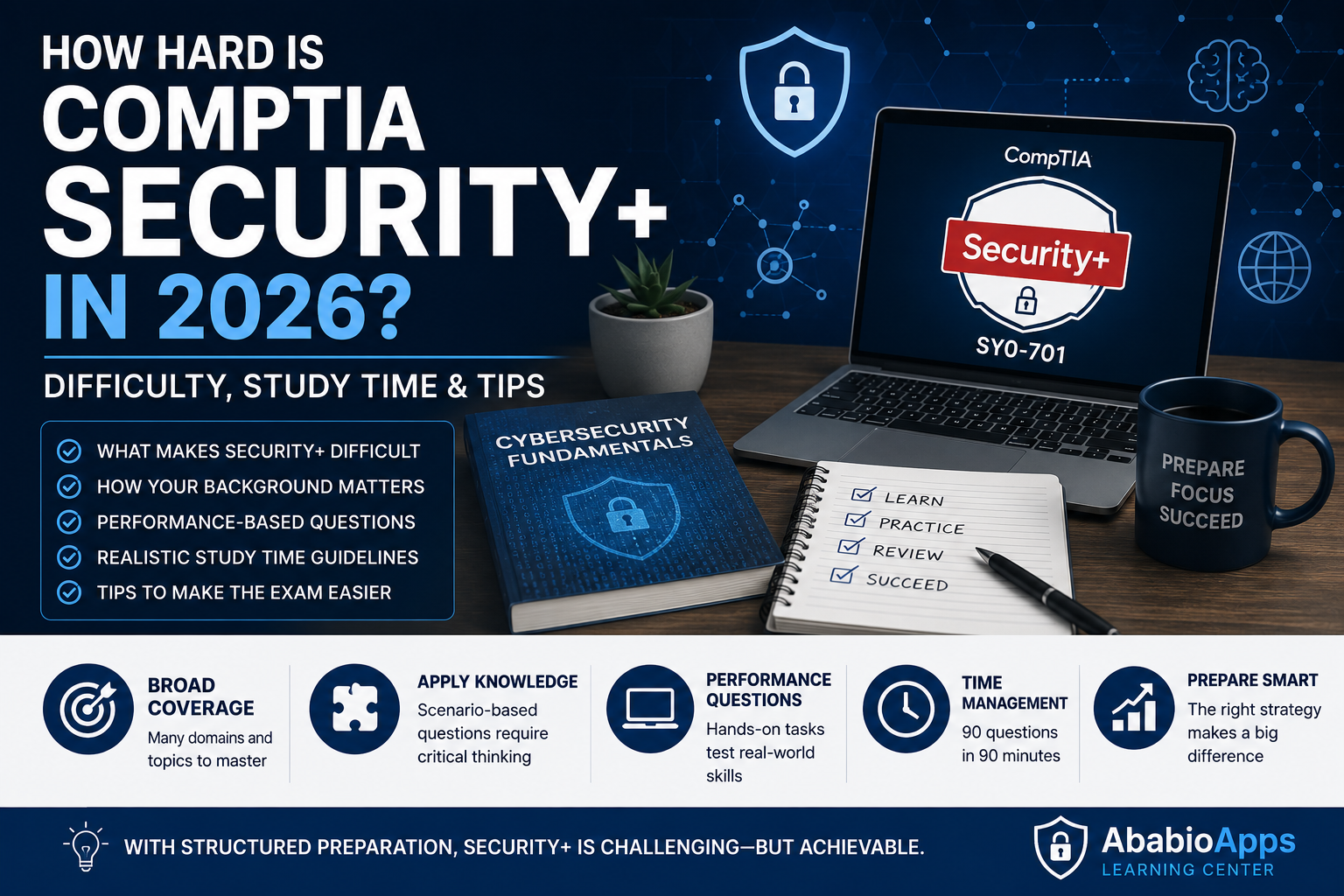
Is Security+ hard?
Security+ is challenging, but it is absolutely manageable with structured preparation. The biggest difficulty is not necessarily one extremely complicated topic. It is the combination of a broad syllabus, technical terminology, scenario-based questions, performance-based questions, and the need to understand why an answer is correct.
If you are researching CompTIA Security+, there is a good chance you have already seen people describe the exam in completely different ways.
"Security+ is easy."
"Security+ is extremely difficult."
Both opinions can be true for different people.
Your experience with networking, operating systems, cybersecurity, troubleshooting, and technical concepts can dramatically change how difficult the exam feels.
The current Security+ exam is SY0-701 . CompTIA lists a maximum of 90 questions, multiple-choice and performance-based questions, a 90-minute testing period, and a passing score of 750 on a 100–900 scale. :contentReference[oaicite:1]{index=1}
So the better question is not simply:
"Is Security+ hard?"
It is: "What makes Security+ difficult, and how prepared am I for those challenges?"
How Hard Is CompTIA Security+?
There is no universal difficulty rating for Security+ because your starting point matters enormously.
Someone who has spent several years working with networks, systems, identity, security controls, and troubleshooting may recognize many concepts during preparation.
Someone with no IT experience may encounter networking, authentication, encryption, vulnerabilities, security architecture, logging, incident response, and governance concepts for the first time.
Experienced IT Learner
Existing networking and systems knowledge can make many Security+ concepts easier to recognize.
Typical challenge:Learning security-specific terminology and applying concepts to scenarios.
New to IT
Almost every domain can introduce new terminology and technical concepts.
Typical challenge:Building the underlying IT and networking knowledge while learning cybersecurity.
This is why two candidates can study for the same exam and have completely different experiences.
What Makes Security+ Difficult?
The difficulty of Security+ comes from several factors working together.
Broad Coverage
Security+ covers many areas of cybersecurity. You are not studying one tool or one technology. You are learning how different security concepts fit together.
Scenario-Based Questions
Questions may describe a situation and ask you to select the best response. Knowing a definition is not always enough.
Performance-Based Questions
Security+ includes performance-based questions in addition to multiple-choice questions. This means preparation should go beyond simply reading definitions.
Similar-Sounding Concepts
Security terminology can contain concepts that appear similar. Understanding the difference between them is more valuable than memorizing isolated words.
Time Pressure
You need to read questions carefully, identify what the scenario is asking, eliminate weak choices, and make decisions within the testing period.
Your IT Background Can Change the Difficulty
One of the biggest factors affecting Security+ difficulty is what you already know.
Networking Knowledge
Understanding IP addressing, ports, protocols, network segmentation, routing, and common network technologies can make security topics easier to understand.
Systems Knowledge
Familiarity with operating systems, accounts, permissions, services, processes, and troubleshooting provides useful context.
Security Experience
People who have already worked with security tools, policies, logs, alerts, or incident response may recognize concepts more quickly.
No Technical Background
You may need more time to establish the underlying IT concepts before Security+ material becomes comfortable.
CompTIA lists Network+ and two years of experience working in a security or systems administrator role as recommended experience for SY0-701. :contentReference[oaicite:2]{index=2}
Notice the word: recommended. These are recommendations for preparation, not a statement that you must already have those credentials or years of experience before taking the exam.
Are Security+ Performance-Based Questions Hard?
They can be one of the more intimidating parts of the exam, particularly if your preparation has consisted almost entirely of flashcards and multiple-choice questions.
Performance-based questions are designed to assess your ability to apply knowledge rather than simply recognize a definition.
Don't prepare only for definitions
When studying a security concept, ask yourself what you would actually do if you encountered it in a real environment. Think about configuration, analysis, troubleshooting, mitigation, and decision-making.
CompTIA specifically identifies the current exam as containing both multiple-choice and performance-based questions. :contentReference[oaicite:3]{index=3}
Can You Pass Security+ by Memorizing Everything?
Memorization can help, but it should not be the entire strategy.
You will encounter terminology, acronyms, technologies, controls, protocols, frameworks, and security concepts that need to be remembered. But successful preparation also requires you to understand how those concepts are used.
Memorization
- Terms
- Acronyms
- Definitions
- Concepts
Application
- Scenario analysis
- Troubleshooting
- Choosing appropriate controls
- Identifying the best response
The strongest preparation combines both.
How Long Should You Study for Security+?
There is no single study period that works for everyone.
Someone with years of IT experience may be able to move through familiar concepts quickly. Someone new to networking or systems may need additional time before focusing heavily on exam-specific practice.
Identify what you already know.
Study the concepts you need.
Test your understanding.
Focus on recurring weak areas.
If you already have a strong technical foundation, a focused one-month plan may be realistic. Our guide Can You Pass Security+ in One Month? walks through one approach to an intensive 30-day preparation schedule.
If you need more time, there is nothing wrong with taking a slower approach. Consistent progress is usually more valuable than rushing through material you do not understand.
Is Security+ Hard for Beginners?
Security+ can be challenging for beginners, especially those who are completely new to IT.
That does not mean beginners cannot pass. It means the preparation path may need to be longer.
Beginner With IT Knowledge
If you already understand basic networking, operating systems, troubleshooting, and computer concepts, Security+ may be a reasonable next step.
Complete Technology Beginner
Consider building basic IT and networking knowledge first. This can make the Security+ material much easier to understand.
If you are still deciding whether the certification makes sense for you, read our guide: Is CompTIA Security+ Worth It in 2026?
How to Make Security+ Easier
You cannot remove the material from the exam, but you can make preparation much more manageable.
Start With the Exam Objectives
Use the official objectives as the framework for your preparation. This keeps your study sessions focused.
Study in Smaller Sessions
Breaking a large syllabus into manageable topics makes it easier to track progress and identify weak areas.
Practice Instead of Only Reading
Questions force you to retrieve information and make decisions. Use them to identify what you actually understand.
Review Your Mistakes
Do not simply record your score. Determine why you missed a question and what concept caused the mistake.
Connect Concepts to Real Systems
Whenever possible, use labs, demonstrations, tools, and practical exercises to connect theory with real-world security tasks.
Security+ SY0-701 Learning Cards
Use short learning sessions to reinforce Security+ concepts throughout your study schedule.
Start LearningSecurity+ Practice Quiz
Test your understanding and identify topics that need more review.
Practice Security+So, How Hard Is Security+?
Security+ is challenging, but it is not an impossible exam.
The biggest mistake is assuming that difficulty comes from memorizing a huge list of terms. The real challenge is understanding a broad range of cybersecurity concepts and applying them to scenarios.
Your IT and networking background can make a significant difference. Your study strategy can make another. And hands-on practice can help turn abstract concepts into something you actually understand.
Security+ becomes more manageable when...
- You understand the fundamentals.
- You follow the exam objectives.
- You practice regularly.
- You analyze your mistakes.
- You connect theory to practical situations.
Security+ becomes harder when...
- You rely entirely on memorization.
- You skip networking fundamentals.
- You never review incorrect answers.
- You study randomly without objectives.
- You wait until the end to practice.
Turn Security+ Difficulty Into a Study Plan
Build your foundation, practice consistently, identify your weak areas, and work through the exam objectives one topic at a time.
Important: Exam difficulty varies by candidate. The information above is intended for educational purposes and should not be treated as a guarantee of exam performance or a specific study timeline.