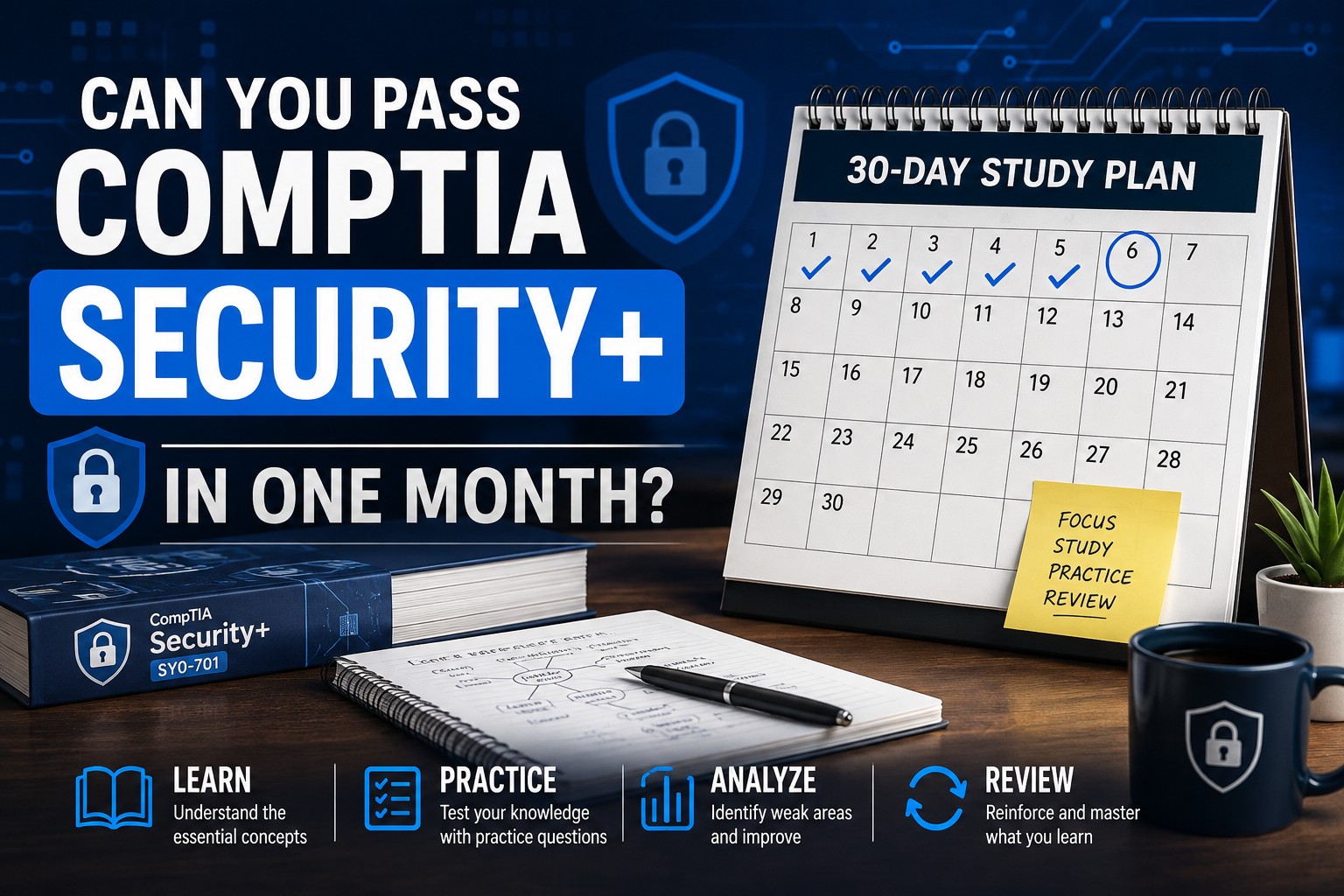
Quick Answer
Yes, it can be possible to pass CompTIA Security+ in one month. However, a 30-day timeline is much more realistic for someone who already has some IT, networking, or cybersecurity knowledge and can study consistently. If you are completely new to IT and cybersecurity, giving yourself additional preparation time may be a better approach.
One of the most common questions people ask before starting Security+ preparation is simple: "Can I pass Security+ in one month?"
The honest answer is that there is no single study timeline that works for everyone. Your starting knowledge matters. So does the amount of time you can dedicate each day, how comfortable you are with networking and IT concepts, and how effectively you review the areas you don't understand.
A focused 30-day plan can nevertheless give you a clear structure instead of spending months studying without knowing whether you're making progress. The goal isn't to memorize hundreds of isolated definitions. The goal is to understand the concepts, recognize how they relate to real security situations, and become comfortable applying that knowledge to exam questions.
Is One Month Really Enough for Security+?
For some candidates, yes. For others, no. The difference usually comes down to starting knowledge, available study time, and consistency.
Someone who already works in IT or networking may recognize many of the concepts covered by Security+. A person completely new to information technology may need considerably more time to understand the same material.
The better question to ask
Instead of asking whether one month is enough for everyone, ask: "Can I consistently learn, review, and practice the Security+ objectives within the next 30 days?"
If you can answer yes and you already have a reasonable IT foundation, a focused month can be a realistic target.
How Difficult Is CompTIA Security+?
CompTIA Security+ can be challenging, especially if you are new to information technology or cybersecurity. The difficulty is not necessarily because every topic is extremely advanced. Instead, Security+ covers a broad range of security concepts and expects you to understand how those concepts apply to different situations.
That means preparing for Security+ is more than memorizing definitions. You need to recognize security concepts, understand why a particular technology or control is being used, and determine which solution makes the most sense in a given scenario.
What makes Security+ challenging?
Depending on your background, you may encounter topics involving:
- Threats, vulnerabilities, and common attacks
- Security architecture and design
- Identity and access management
- Security operations and monitoring
- Incident response and remediation
- Cryptography and public key infrastructure
- Governance, risk, compliance, and security policies
- Secure networking, systems, applications, and cloud environments
The biggest challenge is connecting the dots
Security+ preparation becomes easier when you stop treating every topic as an isolated fact. For example, instead of simply memorizing what a security control does, try to understand what problem it solves, when you would use it, and what risk it helps reduce.
Is Security+ harder for beginners?
It can be. Someone who already understands networking, operating systems, troubleshooting, and basic IT concepts may recognize many of the ideas introduced during Security+ preparation. A person starting from scratch may first need to learn those foundational concepts before the security material becomes easier to understand.
This is why a 30-day Security+ study plan should not be treated as a universal deadline. If you are already comfortable with IT and networking, an intensive month may be realistic. If many of the underlying concepts are completely new to you, extending your preparation period may give you a much better chance of actually understanding the material.
Don't confuse memorization with readiness
Being able to recognize a definition is not the same as being able to apply a security concept to a scenario. If you are consistently guessing on practice questions, use the results to identify what you need to learn rather than simply trying to memorize more answers.
How can you make Security+ easier to study?
Break the material into smaller groups of related concepts instead of trying to learn everything at once. A useful approach is to learn a topic, practice questions about that topic, review your mistakes, and then return to the topic later.
That approach also fits a 30-day preparation schedule because it gives you multiple opportunities to revisit difficult subjects instead of leaving everything for the final few days.
If you are preparing for the current Security+ SY0-701 exam, make sure your study materials and practice questions are aligned with the version of the exam you intend to take.
How Much Should You Study Each Day?
There is no magic number of hours that guarantees a passing score. A consistent schedule is more important than trying to compensate for missed days with extremely long study sessions.
Better suited to a longer preparation timeline.
A more realistic range for an intensive 30-day plan.
Possible for some candidates, but quality matters more than simply adding hours.
If your schedule only allows a small amount of study time each day, don't assume you cannot succeed. Instead, consider extending the preparation period.
Your 30-Day CompTIA Security+ Study Plan
If you are trying to prepare for CompTIA Security+ in one month, your study time needs to be structured. The goal is not to rush through every topic as quickly as possible. Instead, use the 30 days to move through four stages: learn, reinforce, practice, and review.
The plan below gives you a framework for how to study for Security+ in 30 days . Adjust the pace when necessary. If a difficult topic requires another day, understanding it is more valuable than simply checking it off your calendar.
Build your foundation and become familiar with the major Security+ concepts.
Connect security concepts and understand how they apply to real situations.
Use practice questions to expose and attack your weak areas.
Week 4 is your final review
The final week is about consolidating what you already learned, reviewing weak areas, practicing under time pressure, and avoiding unnecessary last-minute cramming.
Learn the Security+ Fundamentals
Start by becoming familiar with the Security+ objectives and identifying the subjects you already understand versus the subjects that are completely new to you.
- Review the Security+ exam objectives.
- Identify your strongest and weakest knowledge areas.
- Learn fundamental security concepts.
- Review common threats, vulnerabilities, and attacks.
- Study basic security controls and defensive concepts.
- Begin answering a small number of practice questions each day.
Connect the Core Security Concepts
During the second week, move from basic vocabulary into the technologies, processes, and security decisions you may encounter when solving scenario-based questions.
- Study identity and access management.
- Review secure architecture and design concepts.
- Study security operations and monitoring.
- Review incident response concepts.
- Connect security controls to the risks they are designed to address.
- Continue daily Security+ practice questions.
- Keep a list of concepts that remain difficult to explain.
Attack Your Weak Security+ Areas
By the third week, practice should become a much larger part of your preparation. Do not simply count how many questions you get right. Use every incorrect answer as a clue about what you need to review.
- Take timed Security+ practice sessions.
- Record topics you repeatedly miss.
- Revisit the underlying concepts behind incorrect answers.
- Practice scenario-based questions.
- Review confusing technologies and terminology.
- Repeat questions from previously weak areas after reviewing them.
Consolidate Your Knowledge
The final week is not the time to start learning everything from scratch. Focus your remaining study time on weak areas, practice, review, and becoming comfortable working through questions without rushing.
- Review your weakest Security+ topics.
- Complete additional practice questions.
- Review important concepts and terminology.
- Practice working through questions under time pressure.
- Revisit questions you previously answered incorrectly.
- Reduce unnecessary last-minute cramming.
- Make sure your study materials match the Security+ exam version you intend to take.
A Simple Daily Security+ Study Routine
A 30-day plan becomes easier to follow when each study session has a repeatable structure. Instead of spending hours randomly jumping between topics, divide your available time between learning, practice, and review.
Study a focused Security+ topic.
Answer questions about what you studied.
Identify why you missed questions.
Return to weak concepts later.
Security+ SY0-701 Learning Cards
Use the interactive learning cards to reinforce Security+ concepts throughout your 30-day preparation schedule.
Start LearningHow to Use Security+ Practice Questions Effectively
Practice questions are one of the best ways to measure whether your Security+ preparation is actually working. But simply answering hundreds of questions is not enough. The real value comes from understanding why an answer is correct, why the other choices are incorrect, and which concept you need to review when you make a mistake.
If you are following a 30-day Security+ study plan , practice questions should gradually become a larger part of your preparation as you move closer to exam day. Between practice sessions, you can also use Security+ SY0-701 learning cards for shorter review sessions.
Answer
Try to answer the question without looking at the explanation or searching for the answer first. Treat each question as an opportunity to test what you actually know.
Analyze
If you get the question wrong, don't just memorize the correct letter. Determine why the correct answer is the best choice and why the alternatives do not fit the scenario.
Review
Go back to the underlying Security+ concept behind the question. If you cannot explain the concept in your own words, you probably need more review.
Repeat
Return to difficult topics later rather than assuming that one correct answer means you have mastered the subject. Repetition helps expose knowledge gaps that are easy to overlook.
Don't obsess over your practice-test score
A practice score is useful, but the number itself is not the most important information. Pay attention to the topics you repeatedly miss . If you keep getting questions about the same subject wrong, that is a signal to stop and review the underlying concept before moving forward.
What Should You Track?
You do not need a complicated spreadsheet to improve your Security+ practice results. Keep track of the concepts that cause you the most difficulty and look for patterns.
These should become priority review areas.
Understanding matters more than memorizing an answer.
Practice making decisions without rushing.
Revisit them later to see whether you actually improved.
Practice Scenario-Based Security+ Questions
Security+ preparation should not rely entirely on memorizing definitions. When practicing, look for questions that require you to interpret a situation and determine the most appropriate security response.
When you encounter a scenario question, ask yourself:
- What security problem is the question describing?
- What information in the scenario actually matters?
- Which security control or concept addresses the problem?
- Why are the other choices less appropriate?
Practice Security+ Questions Online
Use the AbabioApps Security+ quiz to practice questions, identify weak areas, and reinforce concepts as you work through your study plan.
Start the Security+ QuizSecurity+ SY0-701 Learning Cards
If you prefer short, repeated review sessions, use the Security+ learning cards to reinforce concepts throughout your preparation.
Explore Learning CardsThe goal isn't to memorize the quiz
If you recognize the answer only because you have seen the exact question before, you may not have learned the underlying concept. Try to explain the reasoning behind the answer without looking at the choices. Understanding the concept is the real goal.
Common Security+ Study Mistakes
Trying to prepare quickly can make it tempting to focus entirely on memorization. That can be a problem.
Memorizing without understanding
Knowing a definition is useful, but understanding when and why a security control is used is much more valuable.
Ignoring networking fundamentals
Many security concepts make considerably more sense when you understand basic networking, protocols, and architecture.
Taking practice tests too early
Practice questions should help identify gaps. They should not become a substitute for learning the material.
Studying everything equally
Your available study time is limited. Spend additional time on concepts you consistently struggle to understand.
Cramming during the final days
A focused final review is useful, but trying to learn the entire exam at the last minute can create unnecessary stress.
When One Month May Not Be Enough
There is nothing wrong with taking longer than 30 days. In fact, extending your study timeline may be the smarter decision if you are starting with little or no IT experience.
Consider giving yourself more time if:
- You are completely new to IT.
- Networking concepts are unfamiliar.
- You have very limited daily study time.
- You are struggling to understand the core security concepts.
- Practice questions reveal significant knowledge gaps.
Don't let the calendar control your preparation
A 45-day or 60-day preparation plan is better than rushing through the material simply because you decided that you had to pass within 30 days.
Security+ Study Resources
A good preparation strategy usually combines several types of resources rather than relying on a single source.
Can You Really Pass CompTIA Security+ in One Month?
Yes, it is possible to prepare for and pass CompTIA Security+ in one month—but a 30-day timeline is not realistic for everyone.
The biggest factor is not simply how many days you have. It is how much foundational knowledge you already have, how consistently you can study, and whether you are actively learning from your mistakes.
A Month May Be Enough If...
- You already have an IT or networking foundation.
- You can study consistently throughout the month.
- You are willing to focus on the exam objectives.
- You regularly practice Security+ questions.
- You review your mistakes instead of simply memorizing answers.
- You can identify and improve your weak areas before exam day.
Consider More Than 30 Days If...
- You are completely new to IT or cybersecurity.
- Networking and operating-system concepts are unfamiliar.
- You have limited time available for studying each day.
- You are still struggling with basic Security+ terminology.
- Practice questions reveal significant knowledge gaps.
- You need more time to understand rather than memorize the material.
Your goal should be understanding—not simply finishing a 30-day checklist
A study plan is a tool, not a deadline. If you understand the material after 30 days, you may be ready to move toward the exam. If you still have significant gaps, extending your preparation is not failure. It may be the smarter strategy.
A Simple Security+ Preparation Path
If you are starting your Security+ preparation today, keep the process simple:
Understand the security concepts.
Test what you actually know.
Find the concepts you keep missing.
Strengthen your weak areas.
Start Your Security+ Preparation
Use the AbabioApps Security+ learning resources to review concepts, practice questions, and build your confidence as you work toward the exam.
Important: No study plan can guarantee that you will pass an exam. Your preparation time should be based on your background, available study time, understanding of the exam objectives, and readiness.
Frequently Asked Questions
Can you pass CompTIA Security+ in one month?
Yes, some candidates can prepare for and pass Security+ in one month. However, your starting knowledge, available study time, and consistency make a significant difference.
How many hours a day should I study for Security+?
There is no universal number of hours that guarantees success. For an intensive one-month plan, candidates will generally need meaningful daily study time combined with consistent practice and review.
Is Security+ difficult to pass?
Security+ can be challenging because it covers a broad range of cybersecurity concepts. Your existing IT, networking, and security knowledge can significantly affect how difficult the material feels.
Should I use Security+ practice tests?
Practice questions can help you identify knowledge gaps, become familiar with question styles, and reinforce concepts. They work best when combined with actual learning and review.
What is the best way to study for Security+?
A strong approach combines reviewing the exam objectives, learning unfamiliar concepts, practicing questions, analyzing mistakes, and repeatedly reviewing weak areas.